



• Personal
  • Business
    • Small Business
    • Enterprise Business
    • Wholesale
    • Government
  • About AT&T

Access Keys, Skip To Content.

AT&T.

Enterprise Worldwide

 
  • AT&T Enterprise Caribbean & Latin America
  • Inside Caribbean & Latin America
    • Where we are
      • Argentina
      • Brazil
      • Chile
      • Colombia
      • Costa Rica
      • El Salvador
      • Guatemala
      • Mexico
      • Panama
      • Peru
      • Puerto Rico
      • Uruguay
      • Venezuela
    • Leadership Team
  • Services
    • Application Services
    • Cloud Services
    • Hosting Services
    • Mobility Services
    • Network Security
    • Network Services
    • Unified Communications
    • Voice Services
  • Insights and News
    • Events
    • Press Releases
    • Social Responsibility
    • White Papers
    • AT&T Networking Exchange Blog
  • Social Space
  • Contact Us

Heidelberg

Heidelberger Druckmaschinen AG Facts

Business Needs

Tie together a global sales and service organization to improve efficiency and strengthen customer service

Networking Solution

Sourcing the global network from a single supplier ensures consistent standards and end-to-end performance management that support fast-expanding applications

Business Value

Fast, effective customer service that leads to higher satisfaction levels; ability to handle increased volumes more cost effectively

Industry Focus

Global leader in sheet-fed offset printing solutions

Size

18,200 employees in 170 countries, with major sites in Germany, the U.S., China and the UK

Download this case study

Heidelberg [544KB]

One Global Network Helps Heidelberg Stay in the Lead

About Heidelberg

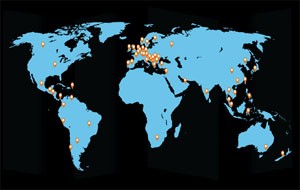
Heidelberg.Building on a tradition of quality and service, Heidelberger Druckmaschinen AG (Heidelberg) is the global leader with more than 40 percent market share in sheet-fed offset printing machinery. Headquartered in Heidelberg, Germany, the company has roots that go back more than 150 years. It has offices in several German cities, including a major manufacturing location in nearby Wiesloch. More than many firms, Heidelberg is truly a global operation. It operates 14 call centers and 250 sales offices in 170 countries, as well as a new manufacturing facility in China.

Situation

Heidelberg had achieved global growth in part through acquisitions that created a hodgepodge of different systems, software and network providers. Dozens of work sites ran their own IT operations, with little thought to interoperation and integration. Employees found it difficult to communicate between locations and IT systems that needed to interoperate often couldn’t. With 100 different network service providers, it was impossible to leverage Heidelberg’s traffic volume to get the best rate. The Heidelberg board turned to outside consultants to recommend ways to improve workflow within Heidelberg. Their advice was clear: consolidate services across the enterprise and assign the work of developing new applications to one central organization, instead of letting everyone work independently.

Solution

Today Heidelberg connects its 60 largest locations over a modern IP-based network using multi-protocol label switching (MPLS) technology from a single provider: AT&T. The powerful unified network now transmits a host of new applications: self-diagnostics reports from intelligent Heidelberg presses, real estate management information such as security images and point-of-sale data, and communications from Heidelberg’s customers. Network volume is increasing rapidly, yet IT costs have been slashed and IT staffing reduced. At the same time, IT services have improved and customer satisfaction is up.

A Drive to Simplify and Focus on the Customer

The popularity of the Internet has not diminished the importance of the printed word as every day the world’s presses print 100 billion 10_14 pages, and that does not include newspapers. Many of those pages flow through presses from Heidelberg.

Heidelberg’s nearly 200,000 customers are found in virtually every country, and many are relatively small businesses employing 20 or fewer people. For these small firms, the press is the center of their business, and if it goes down, the business comes to a halt. For Heidelberg, such a situation is intolerable as customer service is central to the company’s success.

Yet such global operations can pose significant management challenges. In the 1990s, Heidelberg’s leaders realized that the company’s history of growth through acquisitions had created a complex and unwieldy corporate infrastructure. Virtually every one of its dozens of locations had its own IT department, its own unique standard and its own network provider. Doing business, even within the company, was difficult.

“You name the operating system or network system; it was out in the company,” said Howard Hutchings, Vice President for Information Technology. “We had over 100 different providers of network services, but Point A couldn’t communicate with Point B. They were using Windows 98, somebody else was using Windows 2000 and someone else was using Apple. You could not go from one building to the next and have seamless connectivity.” In addition, the lack of a unified approach was costly. It was impossible to leverage Heidelberg’s networking volume with its providers, and the cost undercut Heidelberg’s margins and competitiveness.

Heidelberg decided to simplify and centralize its global IT operations. Among the company’s goals were to enhance customer support, boost efficiency and bottom-line results and streamline workflows.

One Network, Many Connections

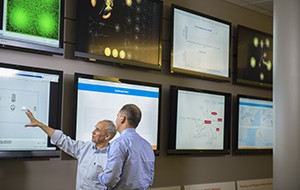
Recruited from Heidelberg’s US operations to manage the unified IT organization, Hutchings looked for a networking provider capable of supporting his company’s worldwide base of employees and customers. “While there were some other big providers in the marketplace,” Hutchings recalled, “we had some good experience with AT&T in the Americas and they had an excellent support staff in our key locations including Germany and the UK. AT&T was moving into Asia Pacific, one of our fastest growing markets, and had the market in America, our number one sales area.” A leadership team visit to the AT&T Network Operations Center in Bedminster, N.J. helped cement the decision.

Today the AT&T MPLS-enabled network connects 60 major Heidelberg locations and carries 70 percent of the company’s fast-growing traffic. Smaller sites are connected through a virtual private network managed by Hutchings’ IT team. With just one network to manage, Heidelberg can focus on applications that put the company’s global connectivity to optimum use.

In addition to the expanding number of sites, another contributor to the growing network traffic is the number of people working from home or on the road. Of Heidelberg’s 18,000 plus staff, 1,000 work at home full time and an additional 4,000 do so occasionally. Sales and service people, designers, data input workers, office workers – even Hutchings and his network managers – need to have connectivity to corporate systems.

Keeping Sales and Service Connected

Where once 80 percent of the value of a press was in steel and machine work, that figure has dropped to 45 percent with the remaining 55 percent dedicated to electronics and software. This is because Heidelberg presses communicate easily with the computers used in graphic design to transform artist concepts into finished printing plates. They also proactively monitor their own performance so when service is needed, the presses use the network to call for help. This built-in self diagnostic capability is an important part of Heidelberg’s pro-active service commitment.

The network has become the backbone - it's vital now that the links are up 7/24/365.

 
“Inside each press is its own little network,” said Hutchings. “Today the machine automatically phones home to the diagnostics people. Any parts needed are automatically drop shipped. The new direction is to have parts that are replaceable by a pressman working on the press, instead of having to send one of our service people. That puts a huge stress on our network because this is live data coming through via the Internet and dropping into our network. We are tying in every small printer around the world.”

Another advanced application – mSALES® and mSERVICE® – connects its 7500 sales and service people in real time over personal digital assistant (PDA) devices. Technicians can receive service orders no matter where they are. When the job is done, they can signal immediately that it is customer-approved. Generating a customer bill used to take days or weeks, but with mSERVICE it takes minutes. As a result, Heidelberg has reduced bills outstanding and improved collections by 25 percent..

Boosted by these and other applications, Heidelberg’s network traffic has grown rapidly, up 45 percent each year for the past four years. Yet, due to their centralized IP-based network, IT costs have been cut by 39 percent in the last five years and staffing has been reduced by 36 percent.

The New Importance of Business Continuity

With the increased reliance on the network, business continuity has taken on an even greater importance. If a press goes down, a small printer’s business is at risk. That’s one reason Heidelberg takes customer service so seriously, supporting customers with contractual agreements on the level of service their presses will deliver. The network plays the same central role in Heidelberg’s own business, both for customer support and the company’s continuing operations. “The network has become the backbone,” says Hutchings. “It’s vital now that the links are up 7/24/365. This is a company wide demand, all the way from the design group doing CAD work to the sales force doing phone calls and sales on the road. Everyone is tied in demanding the network now.

“It was vital to design a network that could sustain business continuity. In the past it was very difficult, especially when we were trying to manage a hundred different providers.” But moving to a single networking vendor made business continuity planning much more straightforward.

“We were able to put together segments of the network that absolutely had to have this robustness to it,” Hutchings continued, “and supplement these with a mixture of backup solutions that AT&T offers. On top of that, I brought in service level monitoring so we are making sure that when we say we’re at 99.99 percent uptime, we can prove that 99.99.”

A Dramatic Gain in Productivity

Its centrally managed network is delivering a dramatic difference in the rich applications, improved workflow, business continuity and the savings that Heidelberg had set out to achieve. In that time Hutchings and his team have reduced the IT budget, trimmed the IT work force, and produced a 300 percent improvement in services delivered. New applications like mSALES and mSERVICE are transforming the way work is done, and helping Heidelberg provide the customer service it is famous for in a whole new way.. Such gains in efficiency and productivity take on new importance as Heidelberg expands into the world’s fastest-growing markets in Africa, China, India and Asia. As much as they need steel and cement, these developing economies need printing. With its world-renowned presses and its world-class network, Heidelberg will be there to serve them.

About AT&T | Support | Careers | Toll Free Directory Assistance | Terms & Conditions | Privacy Policy

© AT&T Intellectual Property. All rights reserved. AT&T, the AT&T logo and all other AT&T
marks contained herein are trademarks of AT&T Intellectual Property and/or AT&T affiliated companies.
36 USC 220506

Proud Sponsor of the U.S. Olympic Team

Hosted by AT&T and powered by 
AT&T Content Acceleration